VOO vs. CSPX (Ireland UCITS)
Quantifying Dividend Tax Drag, the Cost-Basis Reset Penalty, and the $60k Estate Tax Cliff
finfire Quantitative Research Series · Paper #7 · October 2026
In one minute
You live in India. You own ₹1 Cr of an American fund like VOO. Half of that, ₹50 L, is profit you have not sold yet.
People on forums say: move it to an Irish fund like CSPX. It owns the same 500 American companies. But to move, you have to sell VOO first. That sale costs you ₹6.50 L in tax today.
So is the move worth it? We ran the same ₹1 Cr through finfire's accumulate calculator in several versions. Every version started from the exact same numbers. Where the calculator can't do a step yet (the switch itself, the US estate tax, the chance of dying at each age), we used a separate script and we say so.
What we found:
- If you count only the yearly tax on dividends, the move takes 59 years to pay back. Within 30 years it never does. At age 70, the person who stayed in VOO has ₹1.07 Cr more after all tax: ₹30.96 Cr against ₹29.90 Cr.
- The forum math is wrong, but the other way round. The popular shortcut says about 50 years. The real answer is longer (59), because the Irish fund's dividends get taxed twice: once inside the fund, and again when you sell.
- Switching later is worse than switching now. On yearly tax alone, switching at Year 5 leaves you ₹1.98 Cr behind at 70. Switching at Year 10 leaves you ₹2.45 Cr behind. You pay tax on a bigger profit and have fewer years left.
- Then comes the US estate tax, and it changes the answer. If you die holding more than $60,000 of American funds, the US government taxes what you leave behind. Die at 70 still holding VOO, and the US takes ₹12.51 Cr of ₹35.21 Cr (36%). Your family keeps ₹18.45 Cr after their own tax. Had you switched, they would keep ₹29.90 Cr.
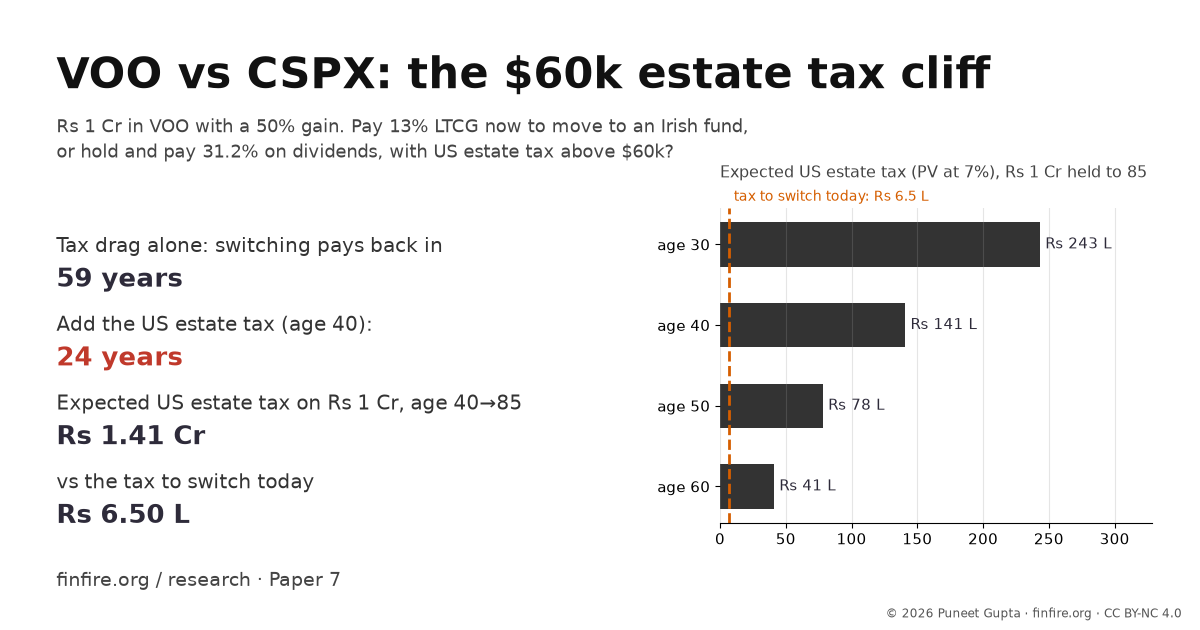
- We weighed that risk by the real chance of dying at each age. For ₹1 Cr of VOO held from 40 to 85, the expected US estate tax is ₹1.41 Cr in today's money. The switch costs ₹6.50 L. That's about 22 times smaller. Count the estate tax, and switching pays back in 24 years, not 59.
- Holding VOO never came out best for the family. We tested every age from 30 to 60 and every size from ₹10 L to ₹4 Cr. Switching beat holding by 4.7% to 30%. Keeping only $60,000 in VOO came close, and won only in one case: ₹10 L at age 60.
- For new money, the Irish fund wins outright. There is no switch tax to pay. With ₹50,000 a month for 30 years, it ends ahead after tax (₹23.75 Cr against ₹23.31 Cr) and carries no US estate tax.
- Moving across apps costs more. Selling on a US app, bringing the money to India and sending it to another broker means paying the currency charge twice and locking ₹14.42 L of TCS for a year. With the estate tax counted, the payback moves from 24 to 29 years.
The short version: On yearly tax alone, holding VOO wins, and by more than most people think. But yearly tax is the small risk. The big risk is the US estate tax your family could face. Once you put that in, the Irish fund came out ahead at almost every age and size we tested.
1. The question
Over the past year, many Indians with US shares have been moving money. They hold US-listed funds like VOO or QQQ, bought through apps like INDmoney, a broker like IBKR, or shares from their employer (RSUs). They are moving into Irish-listed funds like CSPX or VUAA.
They have two reasons:
- Dividend tax every year. VOO pays out part of its profit to you as a dividend. The US cuts 25% before it reaches you. India then taxes it too.
- US estate tax. If you die holding more than $60,000 of American assets, the US can tax what you leave. The top rate is 40%.
For new money, the choice is easy. For money you already hold, it is not. To move, you must sell. Selling makes you pay tax on your profit today.
So we ask three questions:
- How long does the Irish fund take to win back the tax you pay to switch?
- How much is the estate tax risk really worth, in rupees?
- Put the two together: should an existing holder switch now, switch later, trim, or hold?
Words used in this paper
| Word | What it means here |
|---|---|
| VOO | A fund listed in the US that owns the 500 largest US companies (the S&P 500). We use it for any US-listed fund. |
| CSPX / VUAA | Funds listed in Ireland that own the same 500 companies. We use CSPX for any such fund. |
| UCITS | The European rulebook these Irish funds follow. |
| Dividend | A share of company profits, paid out in cash. The S&P 500 pays about 1% a year. |
| Withholding tax | Tax cut at the source, before the money reaches you. |
| Accumulating fund | A fund that keeps its dividends and reinvests them for you. You get no cash, so India has nothing to tax each year. |
| LTCG | Long-term capital gains tax: the tax on your profit when you sell something held more than 24 months. For foreign funds it is 12.5%, plus a 4% cess, so 13%. |
| Cost basis | What you paid. Your taxable profit is the sale price minus the cost basis. |
| Basis reset | When you sell and buy again, your new cost is today's price. So your future taxable profit starts from zero. |
| TER | The fund's yearly fee. VOO charges 0.03%, CSPX 0.07%. |
| US-situs | Counted as American property by US tax law. VOO is. CSPX is not, because it is an Irish company. |
| Estate tax | A tax on what a person leaves behind when they die. |
| Break-even | The number of years until the person who switched catches up with the person who held. |
| Today's money (at 7%) | A future rupee amount pulled back to today, at 7% a year. ₹1.07 in a year is worth ₹1 today. |
2. The set-up
Baseline (Year 0, the same for every path)
| Item | Value |
|---|---|
| Investor | Lives in India, age 40, new tax regime, 30% tax slab |
| Holding | ₹1,00,00,000 (₹1 Cr) in VOO, bought for ₹50,00,000 (half is profit), held more than 24 months |
| Account | IBKR, in US dollars, so switching needs no rupee transfer |
| Growth | 13% a year in rupees: 10% from the S&P 500 in dollars, plus 3% from the rupee falling against the dollar |
| Dividend yield | 1.05% a year (VOO's last 12 months) |
| VOO dividends | US cuts 25%. India tops it up to 31.2% (your 30% slab + 4% cess), after credit for the US tax. The rest is reinvested. |
| CSPX dividends | 15% cut inside the fund under the US–Ireland tax treaty. Nothing paid to you, nothing taxed in India until you sell. |
| Fees | VOO 0.03%, CSPX 0.07% a year |
| Tax when you sell | 13% LTCG on all profit, for both funds |
| Cost of switching | 0.10% of the amount moved (broker fee plus the gap between buy and sell prices) |
| Dollar rate | ₹96.30 per $1 today, with the rupee falling 3% a year |
| New money | None, except in path F |
| Horizon | 30 years, to age 70. Some results run to age 85. |
The paths (all start from the same ₹1 Cr)
| Path | What it does |
|---|---|
| A · Hold VOO | Never switches. Our yardstick. |
| B · Switch now | Sells all VOO at Year 0, pays the tax, buys CSPX. |
| C · Switch at Year 5 | Holds VOO for 5 years, then switches. |
| D · Switch at Year 10 | Holds VOO for 10 years, then switches. |
| E · Trim to the cliff | Keeps only $60,000 in VOO and moves the rest to CSPX. Trims VOO back to $60,000 every year. [harness] |
| F · New money | Adds ₹50,000 a month, rising 5% a year. F1: keep the old VOO, put new money in CSPX. F2: everything in VOO. F3: switch everything now, new money to CSPX. |
| G · Switch across apps | Like B, but the money comes home to India and goes out again to a new broker, paying the currency charge twice and TCS. [harness] |
Assumptions and method
- Calculator: accumulate.finfire.org with Investing abroad (Pro) turned on. It ran every stretch where you hold one fund: paths A, B, C, D, F1, F2, F3, the yearly dividend tax (Figure 3) and the drag-only break-even grids (Figure 4, left). We re-opened all 15 calculator links in a fresh page. 15 of 15 matched to the paisa.
- Harness extension (marked [harness]): a separate script,
scripts/run.js, for what the calculator can't do yet: the switch itself, the tax at sale, the US estate tax, the chance of dying at each age, the yearly trim (E) and TCS (G). It does not change the calculator's code. Its fund maths matches the calculator to ₹0 over 60 years. - Independent check: a plain Python script with no shared code,
scripts/validate.py. 32 of 32 checks match. - LTCG is 13%, because the 4% cess always applies: 12.5% × 1.04 = 13%. The 31.2% dividend rate (30% slab + cess) includes the cess the same way. We also show 12.5%, 14.30% (10% surcharge) and 14.95% (15% surcharge cap).
- Dividend yield is 1.05%, VOO's trailing 12-month yield (August 2026). We also show 0.6%, 1.1%, 1.2% and 1.3%.
- Profit is counted in rupees. Your cost is in rupees at the old dollar rate, and the sale is in rupees at the new rate. So the rupee's fall adds to your taxable profit.
- Foreign tax credit: India lets you subtract the US 25% from your Indian tax on the same dividend, up to the Indian tax. You claim it on Form 44 (Form 67 for years before 2026-27).
- "After tax" (living liquidation): everything is sold at that year and 13% is paid on all profit. This is the fair way to compare a path that has already paid tax with one that has not.
- US estate tax: the US rate schedule (18% to 40%) on the dollar value of US-situs funds, minus a $13,000 credit. That credit is what makes the first $60,000 tax-free. India has no estate tax treaty with the US, so nothing reduces it. CSPX is an Irish company, so it is outside this tax.
- Heirs: India has no inheritance tax. Your heirs keep your original cost, so they still owe 13% on the profit when they sell. We show their value after that tax too.
- Chance of dying: the Indian insured-lives table IALM 2012-14 (Ult.). A death in a year is counted at the year end, before that year's switch or trim.
- Expected estate tax: for each future year, the chance of dying that year × the estate tax due that year, added up. Shown as plain future rupees and in today's money at 7% a year.
- Markets are steady: the same return every year. No crashes, no luck.
- Rules: Indian and US tax rules as on 25 October 2026, FY 2026-27, new regime.
3. The yearly tax on dividends
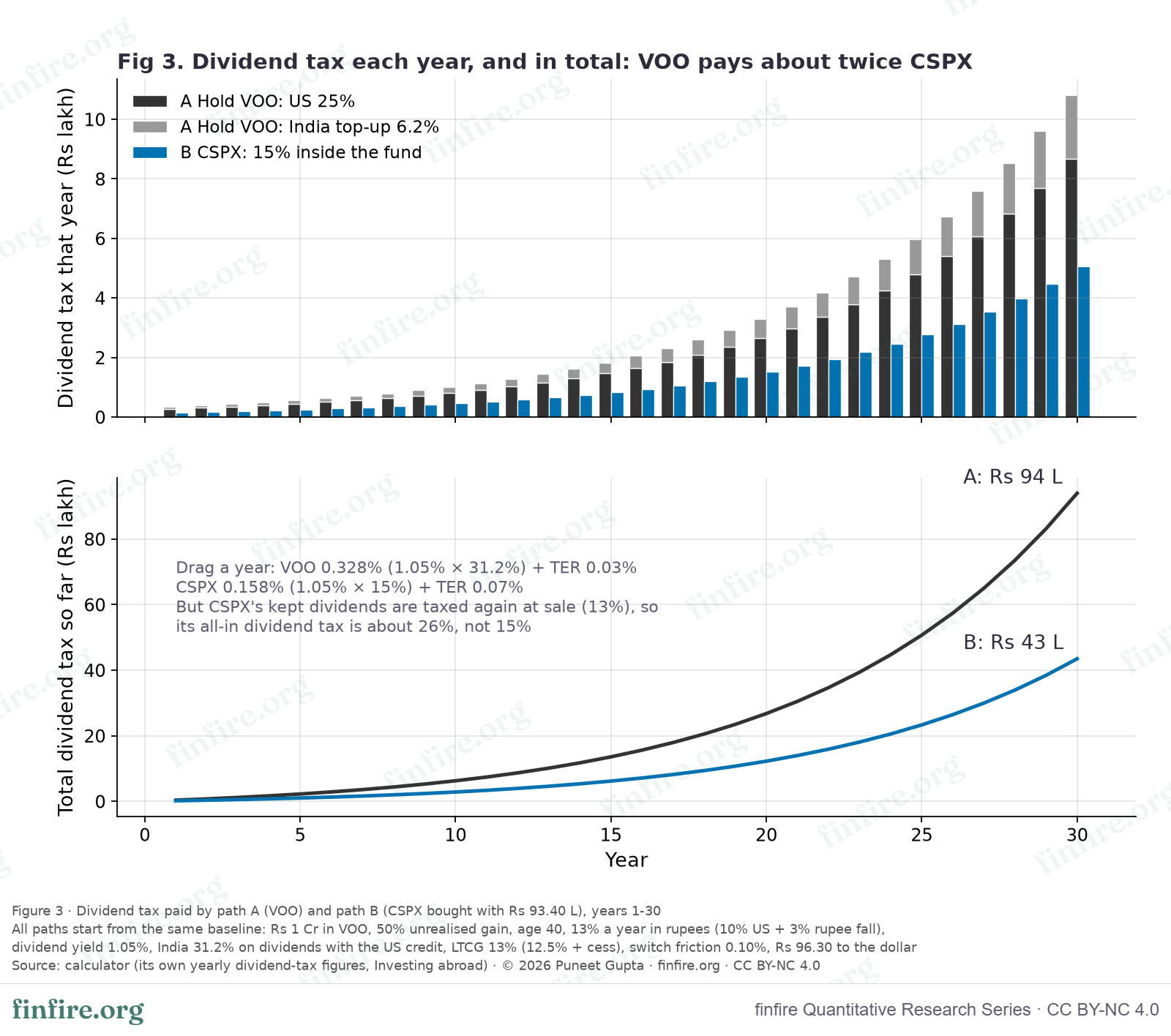
charts/fig3_dividend_drag_data.csv.Each year, VOO's dividend is taxed twice. The US cuts 25%. India then asks for its 31.2%, but gives you credit for the 25% already paid. So you pay India the gap: 6.2%. Total: 31.2%.
CSPX's dividend stays inside the fund. The US cuts 15% before the fund gets it. India taxes nothing that year.
Over 30 years, VOO pays ₹93.94 L of dividend tax. CSPX pays ₹43.46 L. That looks like a big win for CSPX. It is smaller than it looks.
Here's the catch. CSPX keeps the 85% left after the US tax and reinvests it. That money grows your fund. When you finally sell, India taxes that growth at 13%. So CSPX's dividends end up taxed about 26% all-in (15% + 85% × 13%), not 15%.
VOO is different. You pay the full 31.2% each year, then reinvest what's left. That reinvestment counts as a new purchase, so it raises your cost. You are not taxed on it again at sale.
So the real gap is 31.2% against about 26%: about 5 points of the dividend, not 16. On a 1.05% dividend, that's about 0.054% a year. CSPX's higher fee (0.04% more than VOO) eats most of it.
Table 1 · How much the dividend tax slows your money
| Your Indian tax rate on dividends | VOO total dividend tax | VOO slowdown (% a year) | CSPX slowdown (% a year) | Fee gap (% a year) | CSPX lead before tax at sale (% a year) |
|---|---|---|---|---|---|
| 0% (no income tax) | 25.0% | 0.263 | 0.158 | 0.04 | 0.077 |
| 20.8% (20% slab + cess) | 25.0% | 0.263 | 0.158 | 0.04 | 0.077 |
| 31.2% (30% slab + cess) | 31.2% | 0.328 | 0.158 | 0.04 | 0.150 |
| 31.2%, but you forget to claim the credit | 56.2% | 0.590 | 0.158 | 0.04 | 0.442 |
| 35.88% (30% + 15% surcharge + cess) | 35.9% | 0.377 | 0.158 | 0.04 | 0.205 |
Two things stand out:
- If your Indian rate is below 25%, it doesn't matter what it is. The US already took 25%, and India won't refund the extra. So the 0% and 20.8% rows are identical.
- Forgetting the credit is expensive. You pay 25% to the US and the full 31.2% to India: 56.2%. Many people with US shares miss this. If you do, switching pays back in 17 years on yearly tax alone (Section 6).
4. What the switch costs on day one
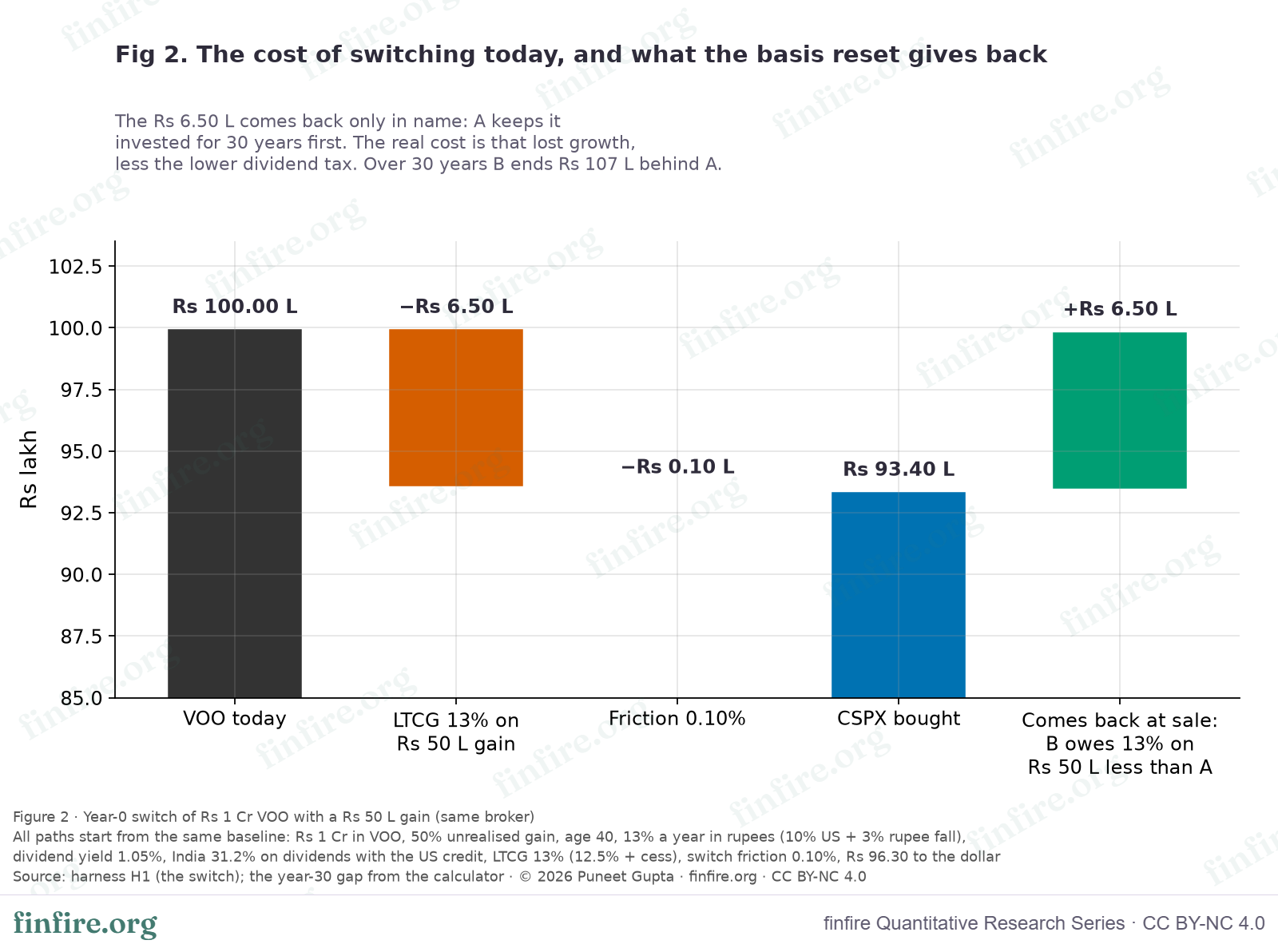
charts/fig2_switch_cost_waterfall_data.csv.Table 2 · The switch, in rupees
| Item | Value |
|---|---|
| VOO today (what you paid) | ₹1.00 Cr (₹50.00 L) |
| B: LTCG at 13% on the ₹50 L profit | ₹6.50 L |
| B: switching cost at 0.10% | ₹10,000 |
| B: CSPX bought | ₹93.40 L |
| E: VOO kept ($60,000 × ₹96.30) | ₹57.78 L |
| E: VOO sold | ₹42.22 L |
| E: LTCG on that sale | ₹2.74 L |
| E: CSPX bought | ₹39.43 L |
| C: at Year 5 — VOO / profit / LTCG / CSPX bought | ₹1.81 Cr / ₹1.26 Cr / ₹16.40 L / ₹1.64 Cr |
| D: at Year 10 — VOO / profit / LTCG / CSPX bought | ₹3.28 Cr / ₹2.64 Cr / ₹34.31 L / ₹2.93 Cr |
The forums call the ₹6.50 L a loss. It isn't quite. The person who holds VOO will also pay 13% on that same ₹50 L profit one day, when they sell. So the switcher is not paying extra tax. They are paying it early.
Paying early has a price, though. The holder keeps that ₹6.50 L invested and growing for 30 years. The switcher doesn't. That lost growth is the real cost of switching.
Notice also how the bill grows if you wait. Switch now: ₹6.50 L. At Year 5: ₹16.40 L. At Year 10: ₹34.31 L.
5. Thirty years, tax drag only: holding wins
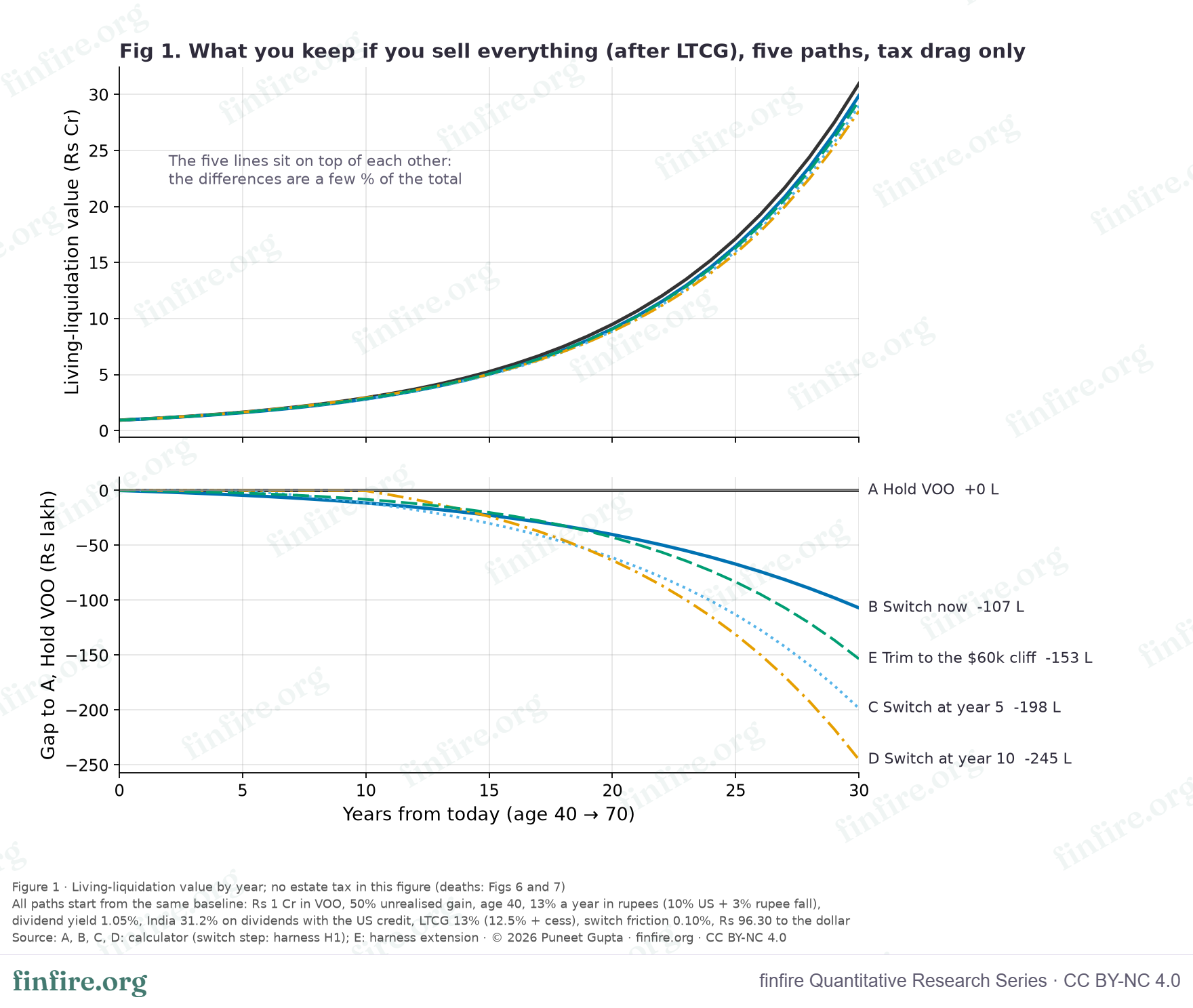
charts/fig1_trajectories_living_liquidation_data.csv.Table 3 · What you keep after selling everything (13% LTCG paid)
| Path | Year 5 (age 45) | Year 10 (50) | Year 20 (60) | Year 30 (70) | Behind A at Year 30 |
|---|---|---|---|---|---|
| A Hold VOO | ₹1.65 Cr | ₹2.93 Cr | ₹9.49 Cr | ₹30.96 Cr | — |
| B Switch now | ₹1.60 Cr | ₹2.82 Cr | ₹9.09 Cr | ₹29.90 Cr | −₹1.07 Cr |
| C Switch at Year 5 | ₹1.64 Cr | ₹2.82 Cr | ₹8.87 Cr | ₹28.98 Cr | −₹1.98 Cr |
| D Switch at Year 10 | ₹1.65 Cr | ₹2.93 Cr | ₹8.85 Cr | ₹28.51 Cr | −₹2.45 Cr |
| E Trim to the cliff [harness] | ₹1.62 Cr | ₹2.85 Cr | ₹9.06 Cr | ₹29.43 Cr | −₹1.53 Cr |
| G Switch across apps [harness] | ₹1.55 Cr | ₹2.73 Cr | ₹8.80 Cr | ₹28.94 Cr | −₹2.03 Cr |
The full year-by-year table, with values before tax and dividend tax paid, is in the Appendix.
On yearly tax alone, every switch path is behind VOO for all 30 years. The gap only grows.
Table 4 · How many years until switching catches up
| Path | The forum view (tax treated as lost) | The real view (tax at sale on both sides) | Real view + expected estate tax, age 40 [harness] |
|---|---|---|---|
| B Switch now | 52 | 59 | 24 |
| C Switch at Year 5 (years after switching) | never within 55 years | never within 55 years | 24 |
| D Switch at Year 10 (years after switching) | never within 50 years | never within 50 years | 22 |
| E Trim to the cliff | — | never within 60 years | 26 |
The popular rule of thumb (tax paid ÷ first year's tax saving) gives 50.0 years.
Why the forum answer is too short
Most people do this sum: "I lose ₹6.50 L. CSPX saves me a bit of dividend tax every year. How long until the savings add up to ₹6.50 L?" That gives 50 to 52 years.
The real sum has two more parts, and they pull in opposite directions:
- It helps the switcher: the holder still owes 13% on that old ₹50 L profit when they sell. The switcher has already paid it.
- It hurts the switcher: CSPX's reinvested dividends get taxed again at sale (Section 3). VOO's don't.
The second part is bigger. So the real answer is 59 years, not 52.
Why switching later is worse
C and D never catch up on yearly tax alone. When you switch later, your profit is bigger, so the tax bill is bigger. And you have fewer years left for the small yearly saving to add up. If you're going to switch, the yearly-tax numbers say: earlier costs less.
Trimming to $60,000 (E) doesn't beat a full switch either. Each yearly trim sells VOO that has grown, so you pay tax early again and again. The VOO you keep still carries the higher dividend tax.
6. The $60,000 cliff
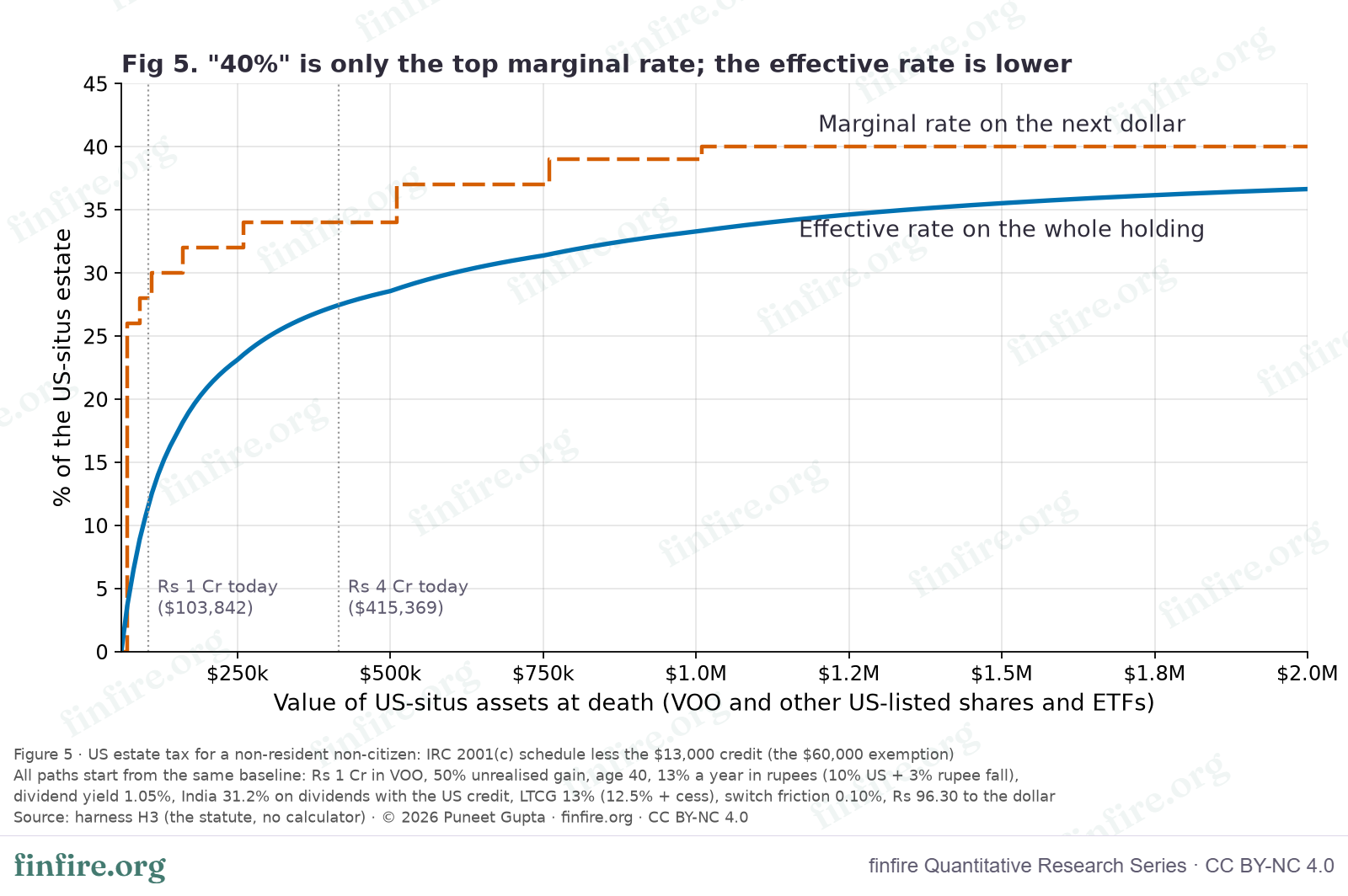
charts/fig5_estate_tax_rates_data.csv.For Americans, the US estate tax only starts above $15 million. For you, it starts above $60,000. That number has not been raised for inflation in decades. India has no treaty with the US to soften it.
"40%" is the top rate, not what you'd pay on everything. The rate climbs in steps and reaches 40% only above $1 million. And the first $60,000 is free. So the share of your whole holding taken is lower:
| Your US-listed funds | Rate on the last dollar | US estate tax as a share of the whole |
|---|---|---|
| $60,000 | — | 0% |
| $104k (₹1 Cr today) | 30% | 11.5% (₹11.51 L) |
| $415k (₹4 Cr today) | 34% | about 27.5% |
| $1 million | 39%–40% | about 33% |
| $1,506k (path A at age 70) | 40% | 35.5% (₹12.51 Cr) |
| $2 million | 40% | about 37% |
The trouble is that your holding doesn't stay small. ₹1 Cr today is about $104k. At our growth rate it becomes $253k by 50, $618k by 60 and $1,506k by 70. As it grows, the tax takes a bigger share.
Some practical points:
- It is a real process, not just a number. Your family has to file a US form (Form 706-NA) within 9 months. Brokers usually freeze the account until the US tax is settled.
- It counts all your US-listed holdings. VOO, QQQ, single US shares and vested RSUs all count together toward the $60,000.
- CSPX and VUAA are outside it. They are shares of Irish companies, even though they own American companies.
7. If death comes early: what your family keeps
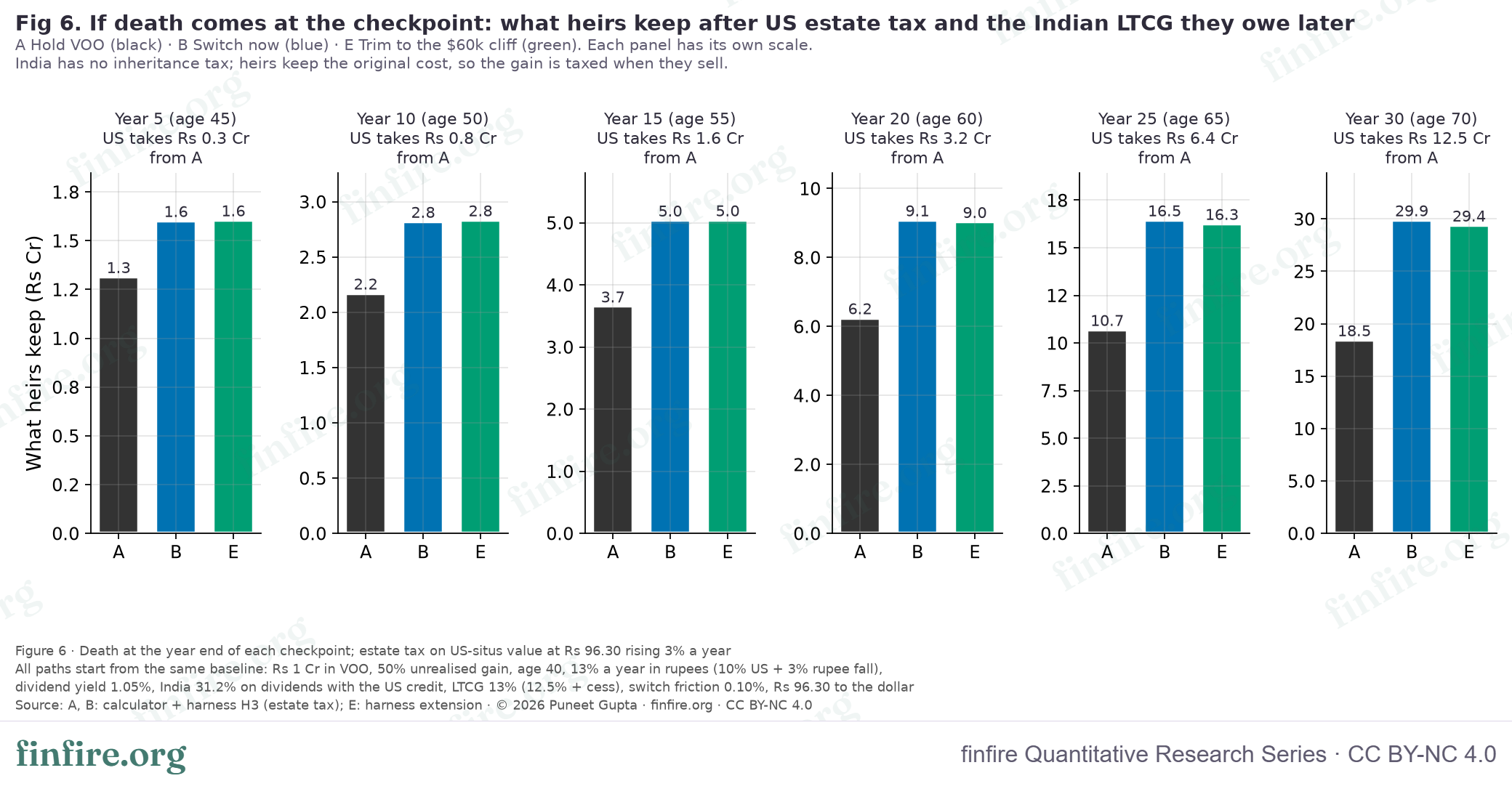
charts/fig6_value_to_heirs_data.csv.Table 5 · What heirs keep, after US estate tax and their own later LTCG
| Death at | A Hold VOO: US estate tax | A: heirs keep | B Switch now: heirs keep | E Trim to the cliff: heirs keep [harness] |
|---|---|---|---|---|
| 40 (Year 0) | ₹11.51 L | ₹81.99 L | ₹93.40 L | ₹93.46 L |
| 45 | ₹33.15 L | ₹1.31 Cr | ₹1.60 Cr | ₹1.61 Cr |
| 50 | ₹76.23 L | ₹2.17 Cr | ₹2.82 Cr | ₹2.83 Cr |
| 55 | ₹1.61 Cr | ₹3.66 Cr | ₹5.04 Cr | ₹5.04 Cr |
| 60 | ₹3.24 Cr | ₹6.25 Cr | ₹9.09 Cr | ₹9.04 Cr |
| 65 | ₹6.43 Cr | ₹10.70 Cr | ₹16.46 Cr | ₹16.27 Cr |
| 70 | ₹12.51 Cr | ₹18.45 Cr | ₹29.90 Cr | ₹29.40 Cr |
At every age, the family keeps more if the money was in CSPX.
Look at the gap at 70. Holding VOO, heirs keep ₹18.45 Cr. After a switch, they keep ₹29.90 Cr. That's ₹11.45 Cr more. On yearly tax alone, the switch was ₹1.07 Cr behind (Section 5). The estate tax is about ten times bigger than the yearly-tax gap.
Trimming to $60,000 (E) keeps almost all of the switch's protection. It carries a small estate tax (₹3.40 L at 70), because VOO grows past $60,000 during each year before it is trimmed again.
The full table for every path, including C and D, is in the Appendix.
8. Putting a price on the risk
Nobody knows when they will die. But insurers know the odds. So we used India's insured-lives table (IALM 2012-14) to weigh each year by its chance.
Think of the result as this: the fair price an insurer would charge you today to cover the US estate tax.
Table 6 · Expected US estate tax, starting at age 40 [harness]
| Path | Up to age 70, future rupees | Up to 70, today's money | Up to 85, future rupees | Up to 85, today's money |
|---|---|---|---|---|
| A Hold VOO | ₹1.20 Cr | ₹22.35 L | ₹19.35 Cr | ₹1.41 Cr |
| B Switch now | ₹0 | ₹0 | ₹0 | ₹0 |
| C Switch at Year 5 | ₹23,816 | ₹18,815 | ₹23,816 | ₹18,815 |
| D Switch at Year 10 | ₹1.17 L | ₹71,263 | ₹1.17 L | ₹71,263 |
| E Trim to the cliff | ₹60,473 | ₹15,070 | ₹2.47 L | ₹28,603 |
| F1 Keep VOO, new money to CSPX | ₹1.20 Cr | ₹22.35 L | ₹19.35 Cr | ₹1.41 Cr |
| F2 Everything in VOO | ₹2.20 Cr | ₹40.39 L | ₹35.38 Cr | ₹2.57 Cr |
| F3 Switch all now, new money to CSPX | ₹0 | ₹0 | ₹0 | ₹0 |
Holding ₹1 Cr of VOO from 40 to 85 carries an expected US estate tax of ₹1.41 Cr in today's money. The switch costs ₹6.50 L. The risk is about 22 times the cost.
Why so big? Because most deaths happen late in life, when the holding is largest and the tax rate is highest. The odds of dying at 80 are much higher than at 45, and by then the VOO holding is many crores.
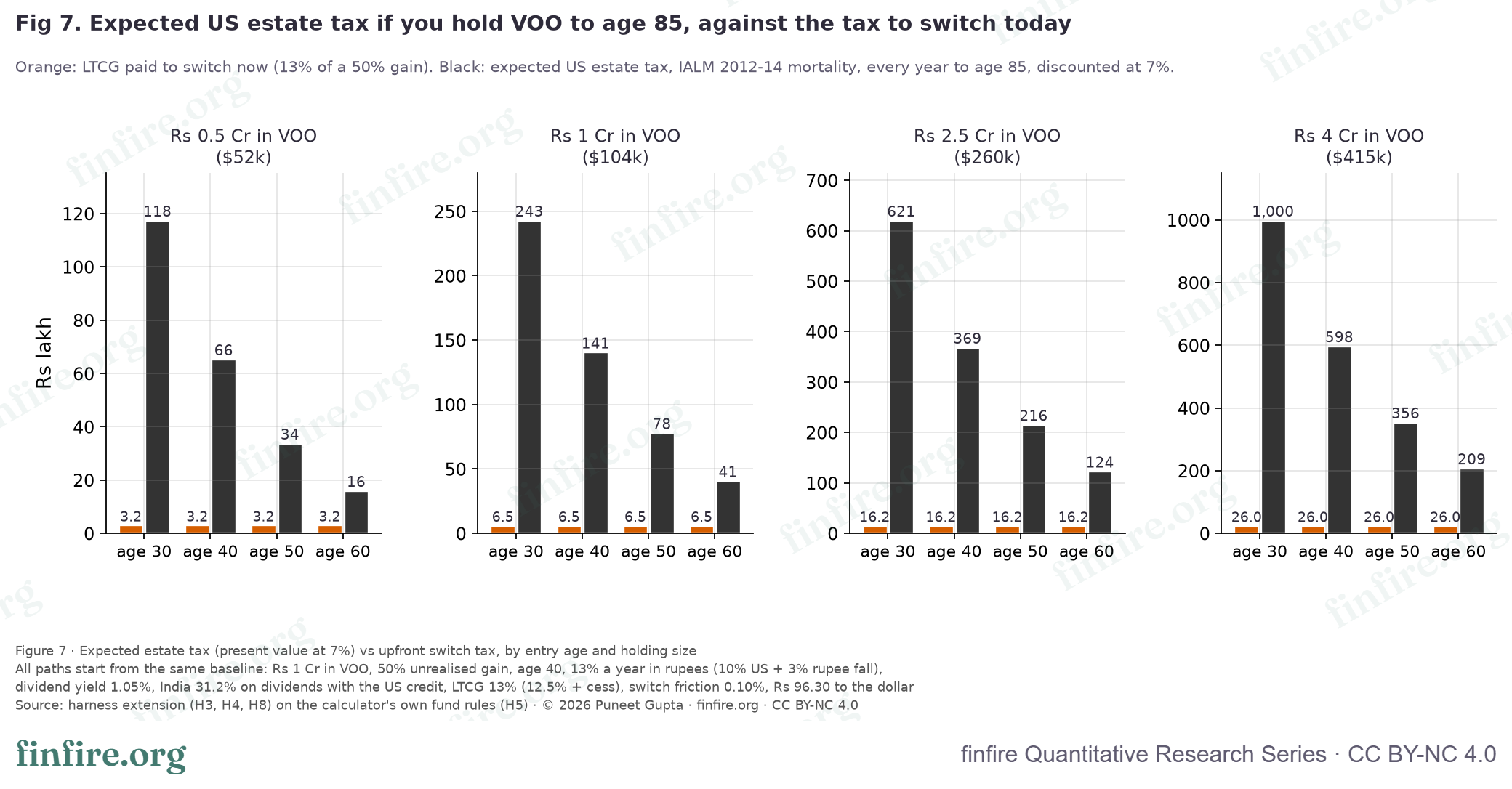
charts/fig7_estate_vs_switch_cost_data.csv.9. Both taxes together: the break-even
To combine the two, we charged path A a fair yearly insurance premium for the estate tax risk. That's the chance of dying that year × the estate tax due. Then we asked again: when does switching catch up?
Answer: 24 years for a switch at 40 (Table 4, last column). Switching at Year 5 catches up 24 years after the switch. Switching at Year 10 catches up after 22.
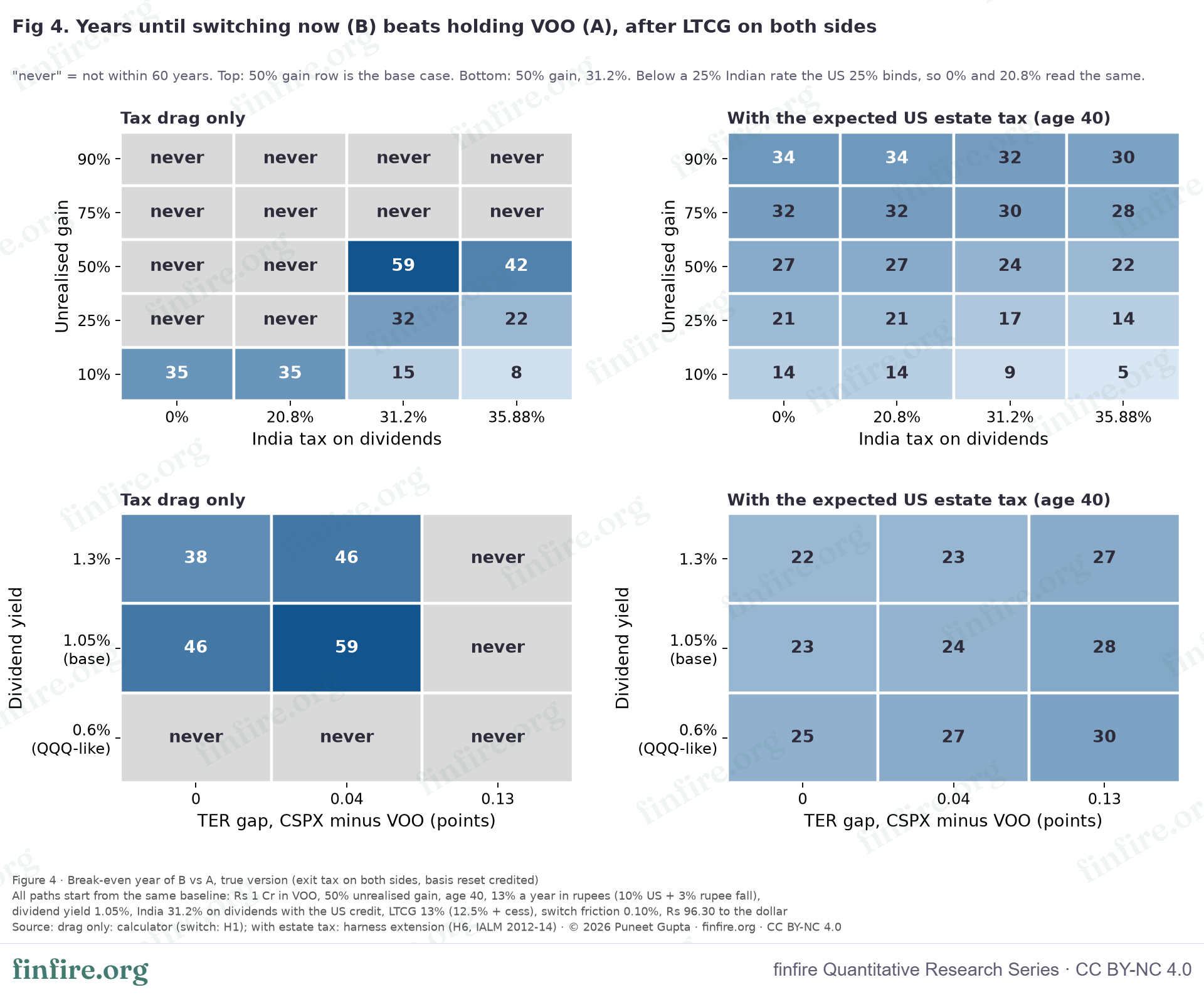
charts/fig4_break_even_heatmaps_data.csv.Table 7 · Break-even by profit size and tax rate (years)
Each cell: yearly tax only / with the expected estate tax at age 40. "Never" means not within 60 years.
| Profit share of your holding | 0% (no income tax) | 20.8% (20% slab) | 31.2% (30% slab) | 35.88% (30% + 15% surcharge) |
|---|---|---|---|---|
| 10% | 35 / 14 | 35 / 14 | 15 / 9 | 8 / 5 |
| 25% | never / 21 | never / 21 | 32 / 17 | 22 / 14 |
| 50% | never / 27 | never / 27 | 59 / 24 | 42 / 22 |
| 75% | never / 32 | never / 32 | never / 30 | never / 28 |
| 90% | never / 34 | never / 34 | never / 32 | never / 30 |
A small profit makes switching cheap. RSUs that vested recently often have little profit in them. At 10% profit and a 30% slab, switching catches up in 15 years on yearly tax alone, and 9 with the estate tax.
A big profit makes switching slow, but the estate tax still makes it pay within 28 to 34 years.
Table 8 · Break-even by dividend yield and fee gap (50% profit, 31.2%)
| Dividend yield | Same fee | Fee gap 0.04% (VOO vs CSPX) | Fee gap 0.13% (QQQ vs CNDX) |
|---|---|---|---|
| 0.6% (like QQQ) | never / 25 | never / 27 | never / 30 |
| 1.05% | 46 / 23 | 59 / 24 | never / 28 |
| 1.3% | 38 / 22 | 46 / 23 | never / 27 |
For a low-dividend fund like QQQ, yearly tax barely matters. Only the estate tax makes the switch pay.
10. What changes the answer
Table 9 · Break-even for switching now (B), years
| Change from our baseline | Forum view | Real view, yearly tax only | With estate tax, age 40 | Trim (E), with estate tax | Forum rule of thumb |
|---|---|---|---|---|---|
| Baseline | 52 | 59 | 24 | 26 | 50.0 |
| Yield 1.1% (calculator default) | 49 | 56 | 24 | 26 | 47.0 |
| Yield 1.2% | 44 | 50 | 24 | 26 | 42.1 |
| Yield 1.3% | 40 | 46 | 23 | 25 | 38.1 |
| Yield 0.6% (like QQQ) | never | never | 27 | 29 | 113.6 |
| LTCG 12.5% (cess left out) | 50 | 56 | 24 | 26 | 48.0 |
| LTCG 14.30% (10% surcharge) | 57 | never | 26 | 28 | 55.0 |
| LTCG 14.95% (15% surcharge cap) | 60 | never | 26 | 29 | 57.5 |
| Surcharge based on the size of each sale (salary ₹30 L) | 57 | never | 26 | 27 | 55.0 |
| High income: dividends 35.88%, LTCG 14.95% | 44 | 49 | 24 | 27 | 41.7 |
| Foreign tax credit not claimed (56.2% on dividends) | 18 | 17 | 13 | 15 | 16.6 |
| Dividend rate 20.8% (US 25% is the floor) | never | never | 27 | 29 | 100.0 |
| Switching cost 0.05% | 51 | 58 | 24 | 26 | 50.0 |
| Switching cost 0.5% | 55 | never | 25 | 27 | 50.0 |
| Same fee on both (0.03%) | 41 | 46 | 23 | 25 | 38.2 |
| Growth 13.3% (10% and 3% multiplied, not added) | 52 | 58 | 24 | 26 | 50.0 |
| Growth 10% in rupees | 52 | never | 25 | 26 | 50.0 |
| Dollar at ₹88 | 52 | 59 | 24 | 26 | 50.0 |
"Never" means not within 60 years.
Look at the "with estate tax" column. It stays between 13 and 27 years in every case. The yearly-tax column jumps around from 17 years to "never". The estate tax is what makes the answer steady.
One note on surcharge. Selling ₹1 Cr of VOO with ₹50 L of profit in one year can push a 30%-slab salaried person's income above ₹50 L. Then a 10% surcharge applies to the switch tax that year (14.30%, not 13%). Spreading the sale across two financial years may avoid it. We show this as a variant.
11. New money: no switch tax, so the Irish fund wins
Table 10 · ₹1 Cr of VOO plus ₹6 L a year (₹50,000 a month), rising 5% a year
| Path | Year | Before tax | After selling everything | US-listed part | US estate tax if death | Heirs keep, after all tax |
|---|---|---|---|---|---|---|
| F1 Keep VOO, new money to CSPX | 10 | ₹4.68 Cr | ₹4.25 Cr | $253k | ₹76.23 L | ₹3.49 Cr |
| F1 | 20 | ₹17.66 Cr | ₹15.77 Cr | $618k | ₹3.24 Cr | ₹12.53 Cr |
| F1 | 30 | ₹61.91 Cr | ₹54.72 Cr | $1,506k | ₹12.51 Cr | ₹42.20 Cr |
| F2 Everything in VOO | 10 | ₹4.67 Cr | ₹4.25 Cr | $360k | ₹1.23 Cr | ₹3.01 Cr |
| F2 | 20 | ₹17.55 Cr | ₹15.71 Cr | $1,009k | ₹5.85 Cr | ₹9.86 Cr |
| F2 | 30 | ₹61.21 Cr | ₹54.28 Cr | $2,619k | ₹22.91 Cr | ₹31.37 Cr |
| F3 Switch all now, new money to CSPX | 10 | ₹4.50 Cr | ₹4.14 Cr | $0k | ₹0 | ₹4.14 Cr |
| F3 | 20 | ₹17.23 Cr | ₹15.37 Cr | $0k | ₹0 | ₹15.37 Cr |
| F3 | 30 | ₹60.93 Cr | ₹53.65 Cr | $0k | ₹0 | ₹53.65 Cr |
Two clear results:
- Putting new money in VOO (F2) is the worst choice on both counts. It ends behind F1 after tax, and its estate tax at 70 is the biggest: ₹22.91 Cr.
- F1 is best if you live; F3 is best for your family. Keeping the old VOO and sending new money to CSPX gives the most after tax at 70 (₹54.72 Cr). But the old VOO still carries the full estate tax. Switching everything now leaves heirs ₹53.65 Cr against ₹42.20 Cr.
TCS on sending money abroad kicks in once you send more than ₹10 L in a year (from Year 12 here). It is the same for F1, F2 and F3, so it doesn't change the ranking.
12. Switching across apps costs more
If your VOO sits on a US investing app that doesn't offer Irish funds, switching means three moves: sell there, bring the dollars home as rupees, then send rupees out again to a broker like IBKR. That costs you in two ways:
- The currency charge, twice: once coming in, once going out.
- TCS: above ₹10 L a year, India collects 20% of what you send abroad. You get it back as a tax credit, but usually only after you file your return. Until then, that money earns nothing.
Table 11 · The cross-app switch (G), with the estate tax [harness]
| Currency charge each way | TCS locked for | TCS paid | Break-even with estate tax, age 40 | After tax at 70 | Behind a same-broker switch |
|---|---|---|---|---|---|
| 0.25% | 0 months | ₹0 | 25 | ₹29.75 Cr | −₹14.82 L |
| 0.25% | 12 months | ₹14.51 L | 28 | ₹29.23 Cr | −₹66.74 L |
| 0.75% | 12 months | ₹14.42 L | 29 | ₹28.94 Cr | −₹95.91 L |
| 0.75% | 18 months | ₹14.42 L | 30 | ₹28.70 Cr | −₹1.19 Cr |
| 1.25% | 12 months | ₹14.33 L | 30 | ₹28.65 Cr | −₹1.25 Cr |
| 1.25% | 18 months | ₹14.33 L | 31 | ₹28.42 Cr | −₹1.48 Cr |
Our baseline is the bold row: 0.75% each way, TCS locked for 12 months. On yearly tax alone, a cross-app switch never catches up within 60 years. With the estate tax, it still does, in 29 years instead of 24.
"0 months" means the TCS is set off at once against your advance tax or salary TDS. If you can do that, ask your employer or tax advisor. It saves real money here. The full grid is in the Appendix.
13. Hold, trim or switch: the decision table
For each age and size, we added up what the family is likely to end up with by age 85 (if death comes in a given year, what heirs keep; if alive at 85, what you keep after selling), weighted by the chance of each, in today's money. Then we picked the best of three: hold VOO, trim to $60,000, or switch everything.
Table 12 · Best choice, and how far ahead of holding it is [harness]
| Age today | ₹10 L | ₹25 L | ₹50 L | ₹1 Cr | ₹2.5 Cr | ₹4 Cr |
|---|---|---|---|---|---|---|
| 30 | Switch +20.5% | Switch +25.1% | Switch +27.3% | Switch +28.5% | Switch +29.4% | Switch +29.6% |
| 40 | Switch +13.2% | Switch +19.2% | Switch +22.8% | Switch +25.2% | Switch +26.9% | Switch +27.4% |
| 50 | Switch +5.1% | Switch +12.2% | Switch +16.8% | Switch +20.6% | Switch +23.8% | Switch +24.8%* |
| 60 | Trim +0.6% | Switch +4.7%* | Switch +10.2% | Switch +14.9% | Switch +19.6%* | Switch +21.3%* |
\* Trimming to $60,000 comes within 0.5% of switching.
How much the same holdings face, for reference:
| Age today | Holding | Switch tax today | Expected US estate tax if held (today's money) |
|---|---|---|---|
| 30 | ₹10 L | ₹65,000 | ₹18.91 L |
| 40 | ₹1 Cr | ₹6.50 L | ₹1.41 Cr |
| 50 | ₹1 Cr | ₹6.50 L | ₹78.22 L |
| 60 | ₹10 L | ₹65,000 | ₹43,082 |
| 60 | ₹1 Cr | ₹6.50 L | ₹41.07 L |
| 60 | ₹4 Cr | ₹26.00 L | ₹2.09 Cr |
The full table for all 24 cases is in the Appendix.
Holding VOO did not win in any of the 24 cases. Even ₹10 L at age 30 is exposed, because ₹10 L today grows far past $60,000 by the time most people die.
The only close case is a small holding late in life: ₹10 L at 60. There it likely stays near $60,000, so trimming wins, by just 0.6%.
Does this depend on the 7% we used to pull future rupees back to today? We re-ran it at 12.5%. Only one case changed: ₹25 L at 60 goes from "switch" to "trim". Every other answer held.
14. What this means for you
These are what the numbers show for our test investor. Your own case may differ. Run your numbers (Section 16).
- Yearly dividend tax is not a good reason to switch. On that alone, holding VOO wins for decades. The forum shortcut understates how long the switch takes to pay back, because CSPX's dividends are taxed again at sale.
- The US estate tax is the real issue. On ₹1 Cr held from 40, its expected cost was about 22 times the switch tax. Holding VOO lost in all 24 age-and-size cases we tested.
- If you do switch, timing matters. Switching later meant a bigger tax bill and fewer years to make it back. Switching earlier cost less in every run.
- Small profits make switching cheap. Recently vested RSUs, or lots bought recently, carry little tax to switch. In our tests, a 10% profit paid back in 9 to 15 years.
- Claim your foreign tax credit. Without it, you pay 56.2% on VOO dividends, not 31.2%. That alone changes the yearly-tax answer from 59 years to 17.
- New money: the Irish fund wins on both counts. No switch tax and no estate tax.
- Switch within the same broker if you can. Going through India adds currency charges twice and locks TCS. It pushed our payback from 24 years to 29.
- Watch the surcharge in the switch year. A big one-year sale can push your income over ₹50 L. Splitting it across two financial years may help.
- The estate tax is a process too. Even small US holdings above $60,000 mean a US filing for your family and a frozen account until it is done.
15. Limitations
- Steady markets. Every year has the same return. Crashes would change the paths, but not the tax rules.
- One average cost. Real brokers track each purchase separately. Selling the lots with the least profit first would cut the switch tax.
- The rupee falls 3% a year, every year. A faster or slower fall changes the dollar value, and so the estate tax.
- Deaths at year end only. Not mid-year.
- Not counted: the time and cost of the US estate process, frozen accounts, lawyer fees, and the tax your heirs may pay when selling shares to pay the US.
- Not counted: other US-situs assets you may own beside VOO, such as single US shares, unvested or vested RSUs, or US cash.
- The mortality table is for insured people in India, who tend to live longer. Women also tend to live longer than this table. Longer lives mean a slightly lower expected estate tax.
- Gifting is not modelled. A non-resident can gift US shares during life with no US gift tax. Indian rules on gifts still apply.
- Tax laws change. All rules are as on 25 October 2026.
- Harness results (E, G, every estate tax figure, the decision table and the combined break-even) cannot yet be run in one click in the calculator. Section 16 shows the closest calculator view.
16. Try this scenario yourself
Every calculator figure in this paper came from a plan you can open in one click. Sign in before you open them. All links use Investing abroad (Pro), and the Compare steps use Compare (Pro), so you need a Pro account.
Part 1 · Hold VOO, or switch today?
Step 1 · Open the "hold VOO" plan. ₹1 Cr, half of it profit, 30 years, in a US-listed fund. → Open Path A, hold VOO · uses Investing abroad (Pro), Of which gains not yet taxed (Pro)
Step 2 · Pin it. Open Compare (Pro) and press Pin this plan (create a baseline plan to compare). It becomes Plan A, a dashed line.
Step 3 · Change it into the switch. Set Current investments to 93,40,000 (₹1 Cr less ₹6.50 L tax and ₹10,000 switching cost). Clear Of which gains not yet taxed, because a fresh purchase has no profit. In Investing abroad, set Where the fund is listed to Ireland (such as CSPX) and Its return to 12.93 (13% less CSPX's 0.07% fee). Or open the finished plan → Open Path B, switch now · Pro
Step 4 · Read the two lines. Before tax at sale, the switch ends at ₹34.22 Cr and the hold at ₹35.21 Cr.
Step 5 · Take off the tax at sale. Work out 13% × (value − cost). For the hold: ₹35.21 Cr − 13% × (₹35.21 Cr − ₹2.57 Cr) = ₹30.96 Cr. For the switch: ₹29.90 Cr. On yearly tax alone, holding is ahead by ₹1.07 Cr.
Step 6 · Now remember the estate tax. If you die at 70 still holding VOO, the US takes about ₹12.51 Cr. The Irish fund owes nothing. (The calculator doesn't add this yet. Section 7 has the numbers.)
Part 2 · New money: US or Irish fund?
Step 7 · Open a new investor's plan. ₹50,000 a month, rising 5% a year, 30 years, US-listed fund. → Open the US-fund plan · uses Investing abroad (Pro), Yearly raise (Pro)
Step 8 · Pin it, then change only the fund: Where the fund is listed → Ireland (such as CSPX), Its return → 12.93. Or → Open the Irish-fund plan · Pro
Step 9 · Read the gap. Before tax at sale: Irish ₹26.70 Cr, US ₹26.00 Cr. After 13% tax at sale: Irish ₹23.75 Cr, US ₹23.31 Cr. No switch tax, so the Irish fund wins, and it carries no US estate tax.
Part 3 · Your own tax rate
Step 10 · Open Path A again and pin it. → Open Path A · Pro
Step 11 · Try a higher income. Set Your tax rate in India on the dividends to 35.88 (30% + 15% surcharge + cess). The value falls to ₹34.70 Cr from ₹35.21 Cr. → Open at 35.88% · Pro
Step 12 · See what forgetting the credit costs. Back at 31.2%, untick India credits the US tax. You now pay 25% + 31.2% = 56.2%. The value falls to ₹32.57 Cr. → Open without the credit · Pro. Not claiming the credit (Form 44; Form 67 before 2026-27) makes switching pay back in about 17 years on yearly tax alone.
Step 13 · Put in your own numbers. Your holding, your share of profit, your tax rate, your years, your fund's dividend yield. Pin one version, change the other, and repeat Part 1.
17. Reproducibility
Everything behind this paper is in the repository folder research/voo-vs-cspx-estate-tax-cliff/:
run_all.shregenerates every number, link, figure and table. We ran it twice; both runs gave identical outputs.baseline.jsonholds the starting numbers shared by every path.inputs/holds every input set, including the IALM 2012-14 mortality table (inputs/ialm_2012_14_ult.csv).data/calculator_links.csvandprebuilt_urls.mdlist all 15 calculator links, the plan each opens and the answer it gives. Each was opened in a fresh copy of the real page byscripts/verify_links.js: 15 of 15 match to the paisa.scripts/run.jsis the harness for the steps the calculator can't do yet. Its fund maths matches the calculator to ₹0 over 60 years.scripts/validate.pyis an independent Python re-check with no shared code: 32 of 32 match.manifest.jsonmaps every figure and table to its input file, script and output.charts/has every figure as PNG and SVG, with the data drawn as CSV.- Calculator version: accumulate
accumulate.htmlcommit46bc03bd56d76863659c46d1c351bbd7a4e52eb8.
Harness-only results (paths E and G, every US estate tax figure, the expected estate tax, the combined break-even and the decision table) have no one-click link. The nearest calculator view is in compare_setups.md.
The text, data and figures are © 2026 Puneet Gupta · finfire.org, licensed CC BY-NC 4.0. The calculators and engine code are not covered.
Appendix
A1 · Every path at every checkpoint
Values in rupees. "After tax" means everything sold and 13% LTCG paid. Dollar at ₹96.30, rupee falling 3% a year.
| Path | Year (age) | Before tax | Before tax ($) | Dividend tax so far | After tax | vs A |
|---|---|---|---|---|---|---|
| A Hold VOO | 0 (40) | ₹1.00 Cr | $104k | ₹0 | ₹93.50 L | ₹0 |
| B Switch now | 0 (40) | ₹93.40 L | $97k | ₹0 | ₹93.40 L | −₹10,000 |
| E Trim to the cliff | 0 (40) | ₹97.21 L | $101k | ₹0 | ₹93.46 L | −₹4,222 |
| G Switch across apps | 0 (40) | ₹92.12 L | $96k | ₹0 | ₹92.12 L | −₹1.38 L |
| A Hold VOO | 5 (45) | ₹1.81 Cr | $162k | ₹2.23 L | ₹1.65 Cr | ₹0 |
| B Switch now | 5 (45) | ₹1.70 Cr | $152k | ₹1.00 L | ₹1.60 Cr | −₹4.41 L |
| C Switch at Year 5 | 5 (45) | ₹1.64 Cr | $147k | ₹2.23 L | ₹1.64 Cr | −₹18,104 |
| E Trim to the cliff | 5 (45) | ₹1.73 Cr | $155k | ₹1.58 L | ₹1.62 Cr | −₹2.42 L |
| G Switch across apps | 5 (45) | ₹1.65 Cr | $148k | ₹94,962 | ₹1.55 Cr | −₹9.35 L |
| A Hold VOO | 10 (50) | ₹3.28 Cr | $253k | ₹6.25 L | ₹2.93 Cr | ₹0 |
| B Switch now | 10 (50) | ₹3.10 Cr | $240k | ₹2.83 L | ₹2.82 Cr | −₹11.40 L |
| C Switch at Year 5 | 10 (50) | ₹3.00 Cr | $232k | ₹3.99 L | ₹2.82 Cr | −₹11.30 L |
| D Switch at Year 10 | 10 (50) | ₹2.93 Cr | $226k | ₹6.25 L | ₹2.93 Cr | −₹32,775 |
| E Trim to the cliff | 10 (50) | ₹3.11 Cr | $240k | ₹4.07 L | ₹2.85 Cr | −₹8.16 L |
| G Switch across apps | 10 (50) | ₹3.00 Cr | $232k | ₹2.72 L | ₹2.73 Cr | −₹20.26 L |
| A Hold VOO | 15 (55) | ₹5.93 Cr | $395k | ₹13.55 L | ₹5.27 Cr | ₹0 |
| B Switch now | 15 (55) | ₹5.65 Cr | $377k | ₹6.16 L | ₹5.04 Cr | −₹22.60 L |
| C Switch at Year 5 | 15 (55) | ₹5.46 Cr | $364k | ₹7.21 L | ₹4.97 Cr | −₹30.00 L |
| D Switch at Year 10 | 15 (55) | ₹5.34 Cr | $356k | ₹9.40 L | ₹5.03 Cr | −₹23.76 L |
| E Trim to the cliff | 15 (55) | ₹5.61 Cr | $374k | ₹8.14 L | ₹5.07 Cr | −₹20.08 L |
| G Switch across apps | 15 (55) | ₹5.47 Cr | $365k | ₹5.94 L | ₹4.88 Cr | −₹38.59 L |
| A Hold VOO | 20 (60) | ₹10.74 Cr | $618k | ₹26.75 L | ₹9.49 Cr | ₹0 |
| B Switch now | 20 (60) | ₹10.30 Cr | $592k | ₹12.23 L | ₹9.09 Cr | −₹40.18 L |
| C Switch at Year 5 | 20 (60) | ₹9.96 Cr | $572k | ₹13.07 L | ₹8.87 Cr | −₹61.26 L |
| D Switch at Year 10 | 20 (60) | ₹9.74 Cr | $560k | ₹15.14 L | ₹8.85 Cr | −₹63.66 L |
| E Trim to the cliff | 20 (60) | ₹10.14 Cr | $583k | ₹14.99 L | ₹9.06 Cr | −₹42.71 L |
| G Switch across apps | 20 (60) | ₹9.97 Cr | $573k | ₹11.82 L | ₹8.80 Cr | −₹69.18 L |
| A Hold VOO | 25 (65) | ₹19.45 Cr | $965k | ₹50.66 L | ₹17.13 Cr | ₹0 |
| B Switch now | 25 (65) | ₹18.78 Cr | $931k | ₹23.30 L | ₹16.46 Cr | −₹67.12 L |
| C Switch at Year 5 | 25 (65) | ₹18.14 Cr | $900k | ₹23.76 L | ₹16.00 Cr | −₹1.13 Cr |
| D Switch at Year 10 | 25 (65) | ₹17.74 Cr | $880k | ₹25.59 L | ₹15.82 Cr | −₹1.31 Cr |
| E Trim to the cliff | 25 (65) | ₹18.39 Cr | $912k | ₹26.85 L | ₹16.30 Cr | −₹83.34 L |
| G Switch across apps | 25 (65) | ₹18.17 Cr | $901k | ₹22.53 L | ₹15.93 Cr | −₹1.20 Cr |
| A Hold VOO | 30 (70) | ₹35.21 Cr | $1,506k | ₹93.94 L | ₹30.96 Cr | ₹0 |
| B Switch now | 30 (70) | ₹34.22 Cr | $1,464k | ₹43.46 L | ₹29.90 Cr | −₹1.07 Cr |
| C Switch at Year 5 | 30 (70) | ₹33.06 Cr | $1,415k | ₹43.25 L | ₹28.98 Cr | −₹1.98 Cr |
| D Switch at Year 10 | 30 (70) | ₹32.34 Cr | $1,383k | ₹44.64 L | ₹28.51 Cr | −₹2.45 Cr |
| E Trim to the cliff | 30 (70) | ₹33.40 Cr | $1,429k | ₹47.71 L | ₹29.43 Cr | −₹1.53 Cr |
| G Switch across apps | 30 (70) | ₹33.12 Cr | $1,417k | ₹42.04 L | ₹28.94 Cr | −₹2.03 Cr |
Before its switch year, C and D are identical to A, so those rows are left out.
A2 · Death at each checkpoint, every path
| Path | Year (age) | US-listed value | US estate tax | Heirs after estate tax | Heirs after estate tax and their later LTCG |
|---|---|---|---|---|---|
| A Hold VOO | 0 (40) | ₹1.00 Cr ($104k) | ₹11.51 L | ₹88.49 L | ₹81.99 L |
| A Hold VOO | 5 (45) | ₹1.81 Cr ($162k) | ₹33.15 L | ₹1.48 Cr | ₹1.31 Cr |
| A Hold VOO | 10 (50) | ₹3.28 Cr ($253k) | ₹76.23 L | ₹2.52 Cr | ₹2.17 Cr |
| A Hold VOO | 15 (55) | ₹5.93 Cr ($395k) | ₹1.61 Cr | ₹4.32 Cr | ₹3.66 Cr |
| A Hold VOO | 20 (60) | ₹10.74 Cr ($618k) | ₹3.24 Cr | ₹7.50 Cr | ₹6.25 Cr |
| A Hold VOO | 25 (65) | ₹19.45 Cr ($965k) | ₹6.43 Cr | ₹13.02 Cr | ₹10.70 Cr |
| A Hold VOO | 30 (70) | ₹35.21 Cr ($1,506k) | ₹12.51 Cr | ₹22.70 Cr | ₹18.45 Cr |
| B Switch now | 0 (40) | ₹0 | ₹0 | ₹93.40 L | ₹93.40 L |
| B Switch now | 5 (45) | ₹0 | ₹0 | ₹1.70 Cr | ₹1.60 Cr |
| B Switch now | 10 (50) | ₹0 | ₹0 | ₹3.10 Cr | ₹2.82 Cr |
| B Switch now | 15 (55) | ₹0 | ₹0 | ₹5.65 Cr | ₹5.04 Cr |
| B Switch now | 20 (60) | ₹0 | ₹0 | ₹10.30 Cr | ₹9.09 Cr |
| B Switch now | 25 (65) | ₹0 | ₹0 | ₹18.78 Cr | ₹16.46 Cr |
| B Switch now | 30 (70) | ₹0 | ₹0 | ₹34.22 Cr | ₹29.90 Cr |
| C Switch at Year 5 | 0 (40) | ₹1.00 Cr ($104k) | ₹11.51 L | ₹88.49 L | ₹81.99 L |
| C Switch at Year 5 | 5 (45) | ₹1.81 Cr ($162k) | ₹33.15 L | ₹1.48 Cr | ₹1.31 Cr |
| C Switch at Year 5 | 10 (50) | ₹0 | ₹0 | ₹3.00 Cr | ₹2.82 Cr |
| C Switch at Year 5 | 15 (55) | ₹0 | ₹0 | ₹5.46 Cr | ₹4.97 Cr |
| C Switch at Year 5 | 20 (60) | ₹0 | ₹0 | ₹9.96 Cr | ₹8.87 Cr |
| C Switch at Year 5 | 25 (65) | ₹0 | ₹0 | ₹18.14 Cr | ₹16.00 Cr |
| C Switch at Year 5 | 30 (70) | ₹0 | ₹0 | ₹33.06 Cr | ₹28.98 Cr |
| D Switch at Year 10 | 0 (40) | ₹1.00 Cr ($104k) | ₹11.51 L | ₹88.49 L | ₹81.99 L |
| D Switch at Year 10 | 5 (45) | ₹1.81 Cr ($162k) | ₹33.15 L | ₹1.48 Cr | ₹1.31 Cr |
| D Switch at Year 10 | 10 (50) | ₹3.28 Cr ($253k) | ₹76.23 L | ₹2.52 Cr | ₹2.17 Cr |
| D Switch at Year 10 | 15 (55) | ₹0 | ₹0 | ₹5.34 Cr | ₹5.03 Cr |
| D Switch at Year 10 | 20 (60) | ₹0 | ₹0 | ₹9.74 Cr | ₹8.85 Cr |
| D Switch at Year 10 | 25 (65) | ₹0 | ₹0 | ₹17.74 Cr | ₹15.82 Cr |
| D Switch at Year 10 | 30 (70) | ₹0 | ₹0 | ₹32.34 Cr | ₹28.51 Cr |
| E Trim to the cliff | 0 (40) | ₹57.78 L ($60k) | ₹0 | ₹97.21 L | ₹93.46 L |
| E Trim to the cliff | 5 (45) | ₹73.23 L ($66k) | ₹1.62 L | ₹1.72 Cr | ₹1.61 Cr |
| E Trim to the cliff | 10 (50) | ₹84.89 L ($66k) | ₹1.88 L | ₹3.10 Cr | ₹2.83 Cr |
| E Trim to the cliff | 15 (55) | ₹98.41 L ($66k) | ₹2.18 L | ₹5.59 Cr | ₹5.04 Cr |
| E Trim to the cliff | 20 (60) | ₹1.14 Cr ($66k) | ₹2.53 L | ₹10.13 Cr | ₹9.04 Cr |
| E Trim to the cliff | 25 (65) | ₹1.32 Cr ($66k) | ₹2.93 L | ₹18.37 Cr | ₹16.27 Cr |
| E Trim to the cliff | 30 (70) | ₹1.53 Cr ($66k) | ₹3.40 L | ₹33.39 Cr | ₹29.40 Cr |
For C and D, a death in the switch year is counted before the switch. For E, it is counted before that year's trim, so E carries a small estate tax on VOO that grew past $60,000 during the year.
A3 · Cross-app switch, full grid [harness]
| Currency charge each way | TCS locked for | TCS paid | Break-even, yearly tax only | With estate tax, age 40 | After tax at 70 | Behind a same-broker switch |
|---|---|---|---|---|---|---|
| 0.25% | 0 months | ₹0 | never within 60 years | 25 | ₹29.75 Cr | −₹14.82 L |
| 0.25% | 6 months | ₹16.18 L | never within 60 years | 27 | ₹29.45 Cr | −₹44.53 L |
| 0.25% | 12 months | ₹14.51 L | never within 60 years | 28 | ₹29.23 Cr | −₹66.74 L |
| 0.25% | 18 months | ₹14.51 L | never within 60 years | 29 | ₹28.99 Cr | −₹90.28 L |
| 0.75% | 0 months | ₹0 | never within 60 years | 27 | ₹29.45 Cr | −₹44.57 L |
| 0.75% | 6 months | ₹16.09 L | never within 60 years | 28 | ₹29.16 Cr | −₹73.96 L |
| 0.75% | 12 months | ₹14.42 L | never within 60 years | 29 | ₹28.94 Cr | −₹95.91 L |
| 0.75% | 18 months | ₹14.42 L | never within 60 years | 30 | ₹28.70 Cr | −₹1.19 Cr |
| 1.25% | 0 months | ₹0 | never within 60 years | 28 | ₹29.15 Cr | −₹74.17 L |
| 1.25% | 6 months | ₹16.00 L | never within 60 years | 30 | ₹28.86 Cr | −₹1.03 Cr |
| 1.25% | 12 months | ₹14.33 L | never within 60 years | 30 | ₹28.65 Cr | −₹1.25 Cr |
| 1.25% | 18 months | ₹14.33 L | never within 60 years | 31 | ₹28.42 Cr | −₹1.48 Cr |
The locked TCS earns nothing. Each refund is sent abroad again, with TCS if that year's ₹10 L is already used up.
A4 · Decision table, all 24 cases [harness]
Expected value to the family to age 85, in today's money at 7%.
| Age | Holding | Switch tax today | Expected estate tax if held (today's money) | Best choice | Ahead of holding by | Same answer at 12.5%? |
|---|---|---|---|---|---|---|
| 30 | ₹10.00 L ($10k) | ₹65,000 | ₹18.91 L | switch | +20.5% | yes |
| 30 | ₹25.00 L ($26k) | ₹1.62 L | ₹55.28 L | switch | +25.1% | yes |
| 30 | ₹50.00 L ($52k) | ₹3.25 L | ₹1.18 Cr | switch | +27.3% | yes |
| 30 | ₹1.00 Cr ($104k) | ₹6.50 L | ₹2.43 Cr | switch | +28.5% | yes |
| 30 | ₹2.50 Cr ($260k) | ₹16.25 L | ₹6.21 Cr | switch | +29.4% | yes |
| 30 | ₹4.00 Cr ($415k) | ₹26.00 L | ₹10.00 Cr | switch | +29.6% | yes |
| 40 | ₹10.00 L ($10k) | ₹65,000 | ₹8.73 L | switch | +13.2% | yes |
| 40 | ₹25.00 L ($26k) | ₹1.62 L | ₹28.89 L | switch | +19.2% | yes |
| 40 | ₹50.00 L ($52k) | ₹3.25 L | ₹65.50 L | switch | +22.8% | yes |
| 40 | ₹1.00 Cr ($104k) | ₹6.50 L | ₹1.41 Cr | switch | +25.2% | yes |
| 40 | ₹2.50 Cr ($260k) | ₹16.25 L | ₹3.69 Cr | switch | +26.9% | yes |
| 40 | ₹4.00 Cr ($415k) | ₹26.00 L | ₹5.98 Cr | switch | +27.4% | yes |
| 50 | ₹10.00 L ($10k) | ₹65,000 | ₹3.15 L | switch | +5.1% | yes |
| 50 | ₹25.00 L ($26k) | ₹1.62 L | ₹13.59 L | switch | +12.2% | yes |
| 50 | ₹50.00 L ($52k) | ₹3.25 L | ₹33.90 L | switch | +16.8% | yes |
| 50 | ₹1.00 Cr ($104k) | ₹6.50 L | ₹78.22 L | switch | +20.6% | yes |
| 50 | ₹2.50 Cr ($260k) | ₹16.25 L | ₹2.16 Cr | switch | +23.8% | yes |
| 50 | ₹4.00 Cr ($415k) | ₹26.00 L | ₹3.56 Cr | switch (trim within 0.5%) | +24.8% | yes |
| 60 | ₹10.00 L ($10k) | ₹65,000 | ₹43,082 | trim to the cliff | +0.6% | yes |
| 60 | ₹25.00 L ($26k) | ₹1.62 L | ₹5.19 L | switch (trim within 0.5%) | +4.7% | trim to the cliff |
| 60 | ₹50.00 L ($52k) | ₹3.25 L | ₹16.14 L | switch | +10.2% | yes |
| 60 | ₹1.00 Cr ($104k) | ₹6.50 L | ₹41.07 L | switch | +14.9% | yes |
| 60 | ₹2.50 Cr ($260k) | ₹16.25 L | ₹1.24 Cr | switch (trim within 0.5%) | +19.6% | yes |
| 60 | ₹4.00 Cr ($415k) | ₹26.00 L | ₹2.09 Cr | switch (trim within 0.5%) | +21.3% | yes |
Every number in this paper rests on assumptions, not forecasts. Tax rules are FY2026-27 under the new regime and may change. None of this constitutes financial, tax, or investment advice. finfire.org operates the calculator and offers paid tiers.
Reproducibility. Every calculator link behind this paper, with the plan it opens and the answer the calculator gives (results the calculator cannot run yet are harness extensions, listed in the paper): urls.csv